
- Health Alert
You Weren't Losing Hair.
You were trading thick hair for thin hair. And everyone noticed before you did.

- Formulated in the USA
- 5 biomimetic peptides
- 90-day clock printed on the box
- 90-day money-back guarantee
You saw the photo.
It wasn’t the first one. It was just the first one you couldn’t explain away.
Overhead lighting. Someone took it from above, without warning. And right there, down the center of your scalp, a line of skin you had never seen before.
You zoomed in.
Closed the app.
Opened it again thirty seconds later.
And then came the part that was worse than the photo.
Your stomach dropped around a question you couldn’t un-ask:
How long have other people been seeing this?
Your husband. Your friends. The woman who sits across from you at work. Your sister, who has been taking photos of you since you were children.
Nobody said anything.
Not because they didn’t see it. Because nobody ever says it.
Your bathroom mirror spent two years showing you what you wanted to see: head-on, in your light, at your angle, with you already knowing exactly where to place the part.
Someone else’s camera showed you what the rest of the world had been looking at.
And that night, you bought something.
Now open your bathroom drawer.
You already know what’s sitting in there.
The rosemary oil a friend swore by. The biotin gummies. The Korean serum in the sleek dropper bottle you bought because the packaging looked serious.
Four bottles. Maybe five.
And not one of them is empty.

All bought on a Tuesday, in the same mood, a few days after the same kind of photo. All abandoned between week five and week seven, on the exact day you looked in the mirror and thought: nothing.
That drawer isn’t a collection of products.
It’s a record. Of every time you let yourself hope and gave up on it in under six weeks.
And here is what nobody had the courage to tell you:
Not one of those bottles was weak.
They were designed for you to quit exactly when you quit.
Day 31.
Pay attention to this math, because it explains the last two years of your life.
A human hair follicle runs on a cycle of roughly 90 days. Inside it sits a resting phase, telogen, that alone takes two to three months, during which the follicle produces nothing visible. It was never meant to.
Now look at the other side of the counter.
The whole argument in one picture.
The refund window shuts two months before the follicle has anything to show you. That gap is not an accident. It’s the shortest window that still sounds generous.
The refund window is 30 days.
The online review gets written in week two.
The woman who feels nothing by Friday tells her friends it didn’t work.
So the beauty industry did the one thing that guarantees next quarter’s revenue. It stopped formulating for the dermal papilla and started formulating for your Friday.
Menthol, for the tingle on first application, because tingle is the sensation the human brain translates as something is happening.
Heavy oils and silicones, for shine that lasts twelve hours and disappears in the next wash.
Expensive fragrance, because smelling good in the shower is the only deliverable any bottle can actually guarantee.
Things you feel on a Saturday morning. And that a starved follicle, four millimeters below the surface, has no way of registering.
And when your follicle reaches week six, deep in the resting phase and returning absolutely nothing, the deadline has already passed.
You don’t ask for your money back. You blame yourself. And you buy another one.
A follicle that starts working again is one less customer buying next month’s bottle.
They didn’t sell you a weak product. They sold you a fast one. And they charged you four times for it.
The mirror lied for 700 days.
Your follicle doesn’t die. It shrinks.
And with every cycle it returns a strand slightly narrower than the last. Nothing vanishes. Nothing falls out never to return. The hair comes back. Just thinner.
This is what the mirror cannot measure.
The number of strands barely moves. The diameter of each one does, and diameter is the one thing the human eye can’t judge across a whole head.
Until the light comes from above.
One cycle is 90 days. Four cycles are a year.
The woman who spots that line of skin in July’s photo didn’t start anything in July. She started two years earlier, and the mirror lied to her across seven hundred consecutive mornings.
And it has no plateau. There is no point at which a miniaturizing follicle decides to stop. The next cycle starts thinner than this one. The one after that starts thinner still.
It’s running right now, while you read this.
The second reason. This one is worse.
Everything in that drawer acts on the strand. The strand is dead tissue, dead from the second it left your scalp. You can coat it, smooth it, plump it for twelve hours. You cannot change what it is.
What decides whether the next strand emerges thick or thin happens four millimeters below, in the dermal papilla.
And the dermal papilla depends on one thing.
Blood.
Not damage. Not dryness. Supply.
The follicle sits at the end of a microscopic capillary network. When that network thins, the follicle switches to rationing: it keeps producing, it just produces less.
Your follicle isn’t hungry. It’s cut off.
Which is why biotin never stood a chance. You spent two years delivering food to a house with no road to it.
Nine things nobody sold you along with the bottle.
1.Your biotin pill may be lying to your doctor.
High-dose biotin interferes with immunoassay blood tests, including thyroid panels and troponin, the marker used to diagnose a heart attack. The FDA has issued a safety communication about it. You may be taking something for your hair that falsifies the exact test that would explain why your hair changed.
2.The 3-second test nobody taught you.
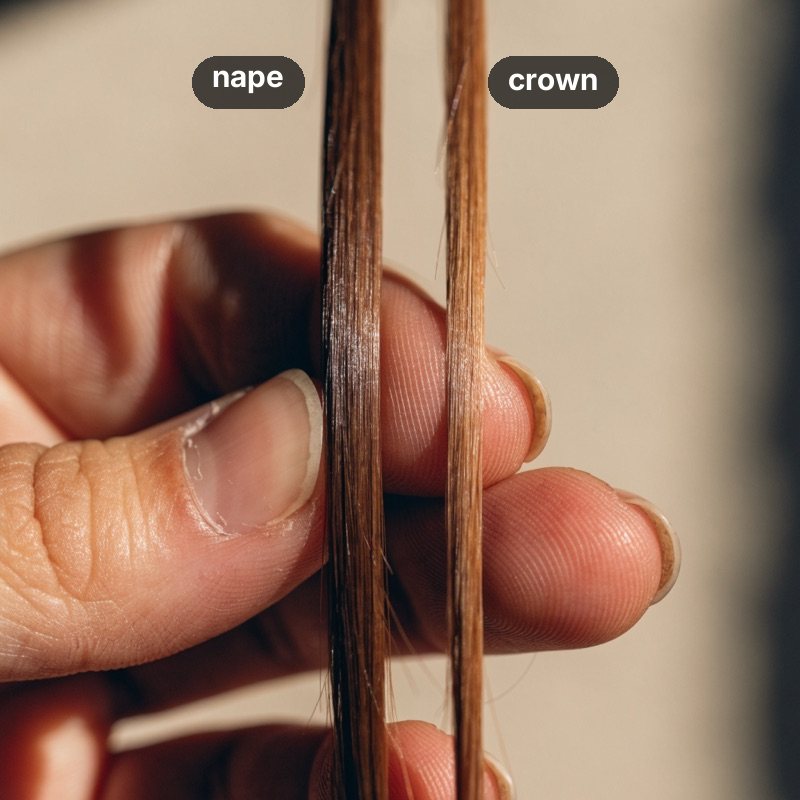
Take a strand from the nape of your neck, the area that’s almost never affected. Take one from the crown. Roll each between your thumb and forefinger. If the crown strand is visibly finer, you aren’t losing hair: you’re partway through miniaturization, and it started earlier than you think.
3.The nightly oil mistake.
Heavy plant oils form an occlusive layer over the scalp. The problem isn’t the oil. It’s that it becomes a wall. Anything you apply afterward stops at the surface and never reaches living skin.
4.The instant-density illusion.
Silicones and cationic polymers coat the dead strand and create the feeling of thicker hair for a few hours. They also accumulate at the base, and buildup at the base is exactly what blocks anything from reaching the scalp the next day.
5.The five-centimeter rule.
The exact way to section the part line so peptides land on living skin instead of getting trapped in the first two millimeters of dead hair.
6.Why counting strands in the drain is the worst possible indicator.
And the one number in your routine that actually tells the truth. You already measure it every morning without realizing.
7.The "it runs in my family" line.
Why genetics is the most convenient sentence in this category: it ends the conversation, requires no testing, and is what’s left over when a $300-a-month treatment doesn’t deliver.
8.Days 14 to 42.
Why more hair comes out before anything improves, and why that’s the only physical proof that something started.
9.Why a 30-day return policy is engineered to expire before biology could possibly give you an answer.
And the part nobody publicized.
A research group at the University of Turin took human hair follicle dermal papilla cells and cultured them alongside human micro-vascular cells, the supply network itself, in the same dish.
Then they introduced a laboratory-made molecule: sh-Polypeptide-9.
It isn’t a vitamin. It isn’t an extract. It isn’t an oil. It is a copy of a signal: specifically, the one your body uses to instruct tissue to build new blood vessels.
It doesn’t feed the follicle. It gives an order.
What the dish showed, published in Experimental Dermatology:
- Treated cells built significantly more vascular structure than the untreated controls
- They released more of the body’s own vessel-building factor
- They expressed more β-catenin, a marker tied directly to follicle signaling
- They were measurably protected from the oxidative stress that shuts follicles down
- And they outperformed the reference compound medicine uses as its benchmark in this category, at lower concentrations
Now the part almost nobody reads in a scientific paper: who paid for it.
Experimental Dermatology
Effects of the biomimetic peptide Sh-Polypeptide 9 (CG-VEGF) on cocultures of human hair follicle dermal papilla cells and microvascular endothelial cells
Bassino E, Zanardi A, Gasparri F, Munaron L. Department of Life Sciences and Systems Biology, University of Turin · Rottapharm-Madaus, Monza · University of Salerno
Exp Dermatol. 2016;25(3):237–239 · doi.org/10.1111/exd.12906
The study was funded by Rottapharm-Madaus, an Italian pharmaceutical company. One of the authors is an employee there. It’s written in the acknowledgements, in small type, at the end of the document.
So: a pharmaceutical company paid to find out whether this molecule worked. The molecule performed.
And ten years later, it isn’t on the shelf of a single major hair brand in the world.
You can draw whatever conclusion you like from that.
This was in vitro laboratory research on cell cultures. It establishes how the molecule behaves. It is not a clinical claim about outcomes on a human head. We write that plainly because everything on this page is meant to be checked, including who funded it.
This is not a serum.
You’ve already bought four. If this were the fifth, you already know exactly how it ends.
Loveri doesn’t make serums. Loveri builds protocols.
A serum is a bottle with a promise. A protocol is a bottle bound by four non-negotiable rules, and we don’t release anything without all four.
01Mechanism
The actual reason your previous attempts stalled, with a name, that you can go look up yourself. Ours is three paragraphs above and it’s called sh-Polypeptide-9.
02A clock
How long it takes, and why that number comes from biology rather than marketing. Ours is 90 days, printed on the box, not buried in an FAQ.
03An advance warning
Between days 14 and 42, more hair will come out than comes out today.
It is not a side effect. It is not “may occur in some users.” It is the thing that has to happen, and the only physical proof that a dormant follicle has re-engaged.
A resting follicle cannot produce a new strand while the old one still occupies the space. It has to evict the old one first. There is no alternative route, no gentle version, no formula that skips the step.
So when you see more hair in the brush in week three, understand what you’re holding: that’s the receipt.
It’s the only thing across ninety days you can actually see and count. And it’s precisely why the industry won’t discuss it: explaining the receipt means admitting the first forty days have nothing to show you.
We email you on day 14 to tell you it’s coming. Before it happens. Not after you’ve thrown the bottle away on day 19.
04A guarantee matched to the clock
Ninety-day cycle. Ninety-day guarantee. Not a day more, not a day less.
No brand on that shelf delivers all four. Most deliver none.
Because all four together mean you can hold us to it. The clock gives you a date. The warning gives you an expectation. The guarantee gives you an exit.
That’s exactly why we write them down.
The 90-Day Scalp Protocol.
Five signaling peptides, sh-Polypeptide-9 among them, with arginine, saw palmetto, Scutellaria baicalensis, rosemary and eucalyptus.
The botanicals have been on shelves for two hundred years. They were never the problem. They just never had anything telling them where to go.

5 signaling peptides
Silicone- and fragrance-free
A 90-day clock
| 5 biomimetic peptides | Cell-signaling molecules, including the sh-Polypeptide-9 from the Turin research |
| Arginine | Amino acid tied to micro-vascular function around the follicle |
| Saw palmetto | Traditional botanical supporting the appearance of fuller-looking hair |
| Scutellaria baicalensis | Root used in traditional medicine for 2,000 years, for scalp balance |
| Rosemary + eucalyptus | The only part of this you’ll feel on night one |
Hormone-free · Fragrance-free · Paraben-free · Phthalate-free · Mineral oil-free · Silicone-free · Vegan · Cruelty-free · 30 ml / 1 fl oz
One bottle is one month. Three bottles are one cycle.
Day 90 isn't about hair.
It’s about the next time someone holds up a phone and says “get in closer.”
And you don’t think about anything.
You don’t work out where the light is coming from. You don’t tilt your head three degrees. You don’t run your hand over your part before looking at the camera.
You just step in.

- It's the hair tie going around three times again, and the third loop pulling snug.
- It's putting your hair up mid-afternoon without finding a mirror first.
- It's the group photo landing in the chat and you opening it without that half-second clench.
- It's wearing it down on an ordinary Wednesday, without that having been a decision.
And above all, it’s no longer running the math.
Checking the ceiling lights when you walk into a restaurant. Choosing which side of the table to sit on. The part you moved to the other side “just for a change.” The hat that became a style.
None of that is vanity. It’s the mental cost of managing something you never chose to manage, and that nobody around you knows is costing you anything.
What disappears on day 90 isn’t the part line. It’s the math.
Now the part no other brand writes.
The clock, printed.
Thirteen days where nothing shows. Twenty-eight where it looks worse. Forty-seven where the count changes.
Days 1–13
Nothing.
You’ll feel the rosemary and eucalyptus. That’s all. That isn’t the product working. That’s the product being cold. Any brand promising visible change here is promising something that doesn’t yet exist biologically. And they know it.
Days 14–42
The receipt.
More strands in the brush. More in the drain. This is where most women throw the bottle away, and it’s where you’ll remember rule three.
You are not losing hair you were keeping. You are watching the exit of a strand that had already finished its work, pushed out by one that’s coming in.
It’s called shedding. It looks, precisely, identical to failure. And the woman who doesn’t know that quits on the exact day it started working. Which is, incidentally, the behavior the entire shelf depends on you repeating.
Days 43–90
The cycle closes.
The strand that entered its growth phase in week three now has the length to count.
And here’s the most important instruction on this page:
Don’t use the mirror. Use the hair tie.
Count the wraps today. Write it down. Photograph your part line, same spot, same light, today and on day 90.
The mirror updates too slowly to register gradual change, which is exactly how it hid this from you for two years.
Photos don’t lie. Hair ties don’t flatter.
One dropper a night. And where it lands matters more than how much.
Not on the hair. On the two inches of exposed skin where your part opens.
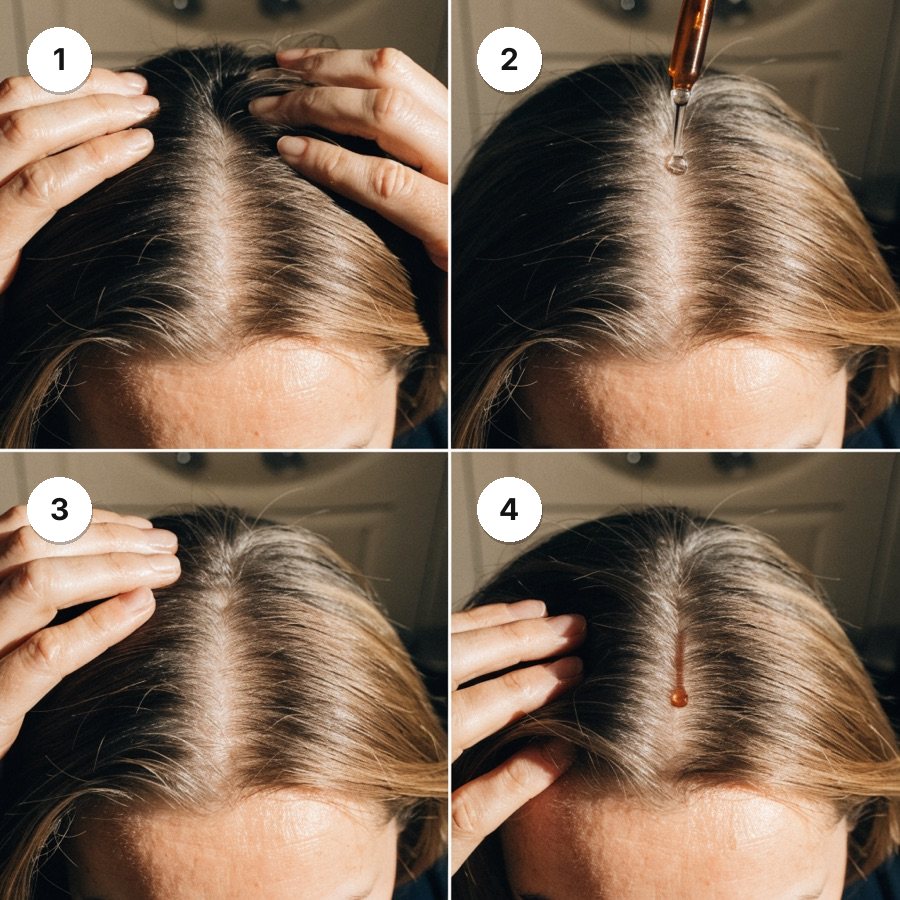
- Separate the part to expose the scalp line.
- A few drops from the dropper directly onto the skin.
- Massage 30 seconds with your fingertips. Not optional: this is what moves it in.
- Shift the part half an inch and repeat until the dropper is empty, about five lines. One full dropper (1 ml) a night.
Don’t rinse. Apply at night.
Only one of them doesn't charge you.
Path one: close this page
The 90-day cycle runs with you or without you. A follicle in rationing mode keeps reducing the diameter of the next strand. Six months from now, the same part line under the same overhead light will demand more angles, more workarounds and more mental energy than you should be spending on this. This path isn’t free. It just bills you later.
Path two: buy bottle number five
The one with the elegant dropper, from the brand with the good ads. It will smell wonderful in week one, seem promising in week two, and be keeping the other four company by week six. You’ve run this test four times. You already know the result.
Path three: run the protocol
The whole cycle, with the clock in your hand, the bad stretch explained before it arrives, and a guarantee covering every one of the ninety days. If your day 90 photo doesn’t show a change, you get 100% of your money back and the cost of the experiment is ours, not yours.
The only financially irresponsible decision on this page is to keep paying the invisible price of doing nothing.
Choose your cycle.
One bottle · 30 days
$59
+ $9 shipping · runs out on day 30, mid-shedding
We’d rather tell you: this ends in the middle of the shedding window. As a test, it isn’t fair to you or to the formula.
Two bottles · 60 days
$94
$47 per bottle · runs out on day 60, before the count changes
- Free US shipping
Three bottles · the complete cycle
$124
$41 per bottle · the only option that reaches day 90
- Free US shipping
- The 90-Day Hair Protocol: a care guide on what to stop doing between weeks 2 and 6, how to wash during shedding, and the exact method for photographing your part line
- Free gift
- The Day 14 Notice, the warning no other brand sends
- 90-day money-back guarantee
Prefer it delivered? Subscribe & Save: three bottles every 90 days at $35 each, or two every 60 at $40. Free shipping, cancel online anytime. The follicle responds while the signal is present, which is the only reason a subscription exists here.
90-day money-back guarantee · free shipping · empty bottles accepted
It isn't a benefit. It's a challenge.
days
- Full refund
- Empty bottles accepted
- No forms, no questions, nothing to return
Ninety days. Full refund. Empty bottles accepted.
Look at any competitor’s guarantee and notice the number: 30 days.
Thirty days is exactly the interval in which it is biologically impossible for you to know anything. It isn’t a coincidence. It isn’t an oversight. It’s the shortest window that still sounds generous.
Ours is 90 because 90 is when you’d actually know, and we’d rather hand you the ruler than hope you never find one.
Finish the cycle. Put your day 90 photo next to day 1. If nothing changed, write to us and every dollar comes back. No forms, no questions, nothing to return.
If any other brand in your drawer had the nerve to do this, you wouldn’t have four bottles in there.
Comments

Karen Whitfield
ok but will I actually see anything in the first month?? I’m so done waiting on stuff 😩
Like · Reply · 1 h

Loveri
No. And anyone telling you otherwise is selling sensation, not results. Month one is the follicle turning over. Month three is when the count changes.
Like · Reply · 48 min

Denise Harper
wait… it makes MORE hair fall out?? 😳
Like · Reply · 2 h
Loveri
Between days 14 and 42, for most people, yes. It’s the follicle evicting the old strand to make room for the new one. It’s the first visible sign the cycle moved, and we email you before it starts.
Like · Reply · 1 h

Lisa Tran
is this like minoxidil? my dermatologist brought that up last year
Like · Reply · 2 h
Loveri
No. Minoxidil is a drug. Loveri is a scalp cosmetic. We don’t compare ourselves to drugs, and you should be wary of any cosmetic that does.
Like · Reply · 2 h

Michelle Brooks
I color every 6 weeks and have tape-in extensions. can I still use it?
Like · Reply · 3 h
Loveri
Yes. It goes on the scalp, not the strand, and it’s free of silicones, mineral oil and sulfates.
Like · Reply · 2 h

Angela Ruiz
what happens if I stop using it later on?
Like · Reply · 4 h
Loveri
The follicle responds while the signal is there. When it stops, behavior gradually returns to where it was. We’d rather tell you now than have you find out in month five.
Like · Reply · 3 h

Tracy Dunn
does it have a smell? fragrance gives me headaches
Like · Reply · 5 h
Loveri
No added fragrance. What you smell is the rosemary and eucalyptus. If you react to botanical scent, this protocol isn’t for you, and we’d rather lose the sale than the trust.
Like · Reply · 4 h
Before you close this page.
That photo wasn’t the first one.
It was just the first one you couldn’t explain away.
And it won’t be the last, because you’re not the one holding the camera, the light isn’t yours, and the angle will never be the one you’d choose.
The 90-day cycle runs either way.
Ninety days from today you’ll be in one of two places.
Holding two photos side by side.
Or opening that drawer again. Five bottles now.
The only thing at stake is whether this cycle runs with signal or without.
And if you’re going to start, start with the clock in your hand.
Every Loveri protocol comes with the clock printed on it.
This one is ninety days: the thirteen where nothing shows, the twenty-eight of the receipt, and the forty-seven where the math changes.
You’ll know where you stand in every one of them.
That’s what all of this was written for.
90-day money-back guarantee · free shipping